Before you buy a cart you plan to drive on the street
Last updated
Check the certificate of origin, the state definition, and the city ordinance before you pay. A listing that says street legal is not a statute.
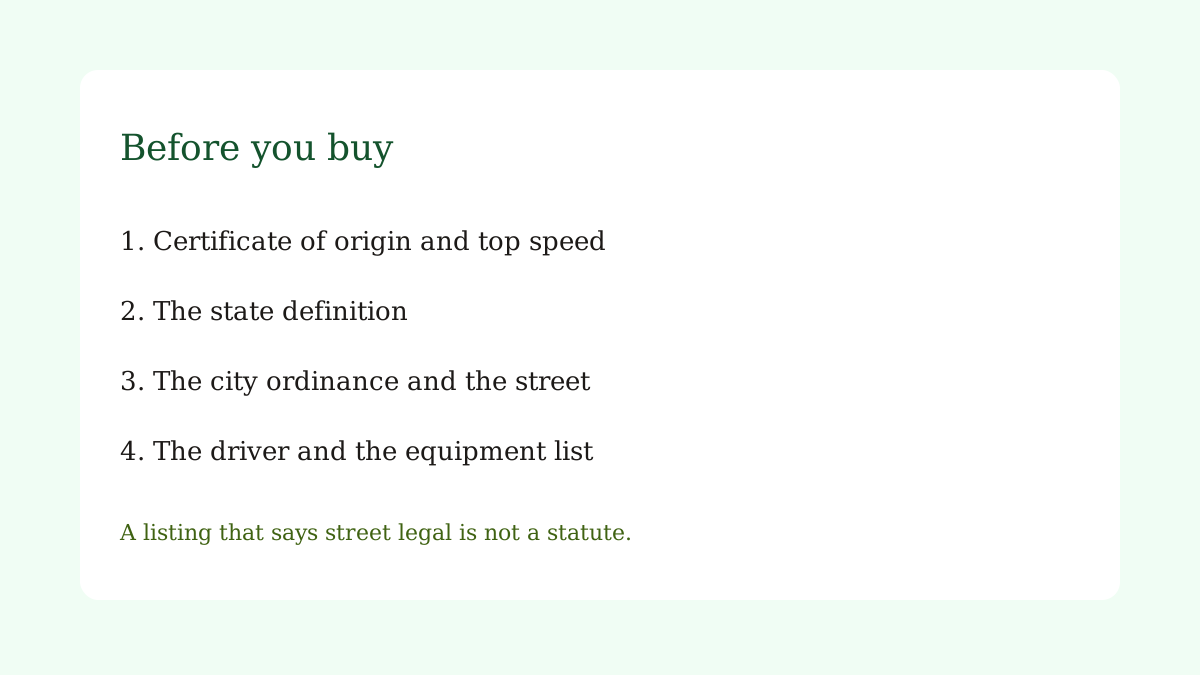
The expensive mistake is buying the cart first and reading the ordinance second. The cart that is perfect for a course can be the wrong category for your street, and the cart that is a genuine low-speed vehicle can be illegal on the fast road you need to cross. An afternoon with the paperwork is cheaper than a cart you cannot register and cannot legally drive to the store.
The paper that comes with the vehicle
Ask for the manufacturer's certificate or statement of origin, any title, and the bill of sale. Read the words. "Low-speed vehicle" or "neighborhood electric vehicle" plus a claim of compliance with 49 CFR 571.500 means you are looking at the federal 20-to-25 mph class. "Golf cart," "off-road," or "for golf course use" means you are probably looking at a vehicle the LSV standard does not cover. Alabama's rule says an off-road-only statement is a reason the vehicle cannot be registered. Alaska wants the certificate to say low-speed vehicle or neighborhood electric vehicle for an LSV registration, and it wants a federal-compliance statement before a passenger registration. If the seller cannot find the origin document, you do not yet know what you are buying. A clean coat of paint is not a substitute.
Write down the stated top speed, the number of seats, the fuel or the battery, and the unladen weight if it is on the plate. California's golf cart is not more than 15 mph and not more than two people. Colorado's golf car is a design speed under 20, not more than four people, not more than 1,300 pounds empty. Kentucky's statutory cart is not more than 35 mph by design, not more than six people, and it has to have the lamps and belts in the definition. A cart that misses the definition never reaches the question of which street it may use.
The state, then the city
Open the state page for the state where you will drive, not the state where the seller is. A Texas golf-cart plate does not answer an Iowa question, and Iowa does not register golf carts under chapter 321 at all. The state page will tell you whether a local ordinance is required. In Florida, Illinois, Indiana, Arkansas, Connecticut, Kentucky, North Carolina, and Ohio, a public-street trip for the slow cart depends on a local act. If the city where you live has no ordinance, a street-legal listing is a listing about some other place.
If we have published the city, read the street list and the fee before you buy. Dunedin's crossings are named. Wynne's highways are named, and the cart in that ordinance cannot exceed 20. Peachtree City wants an in-person registration to an owner who is 18, with decals front and rear. If we have not published the city, email the clerk and ask for the ordinance section before you wire the money. A missing page on this site is not a hidden permission. It means we have not read the ordinance. You still can.
The driver and the equipment, priced in
Check who may drive. If the only licensed driver in the house is not the person who wanted the cart, Florida's under-18 rule, Connecticut's license rule, or North Carolina's age-16 floor may make the purchase pointless. Minnesota's exemption from the license chapter is not a reason to skip the question. The city permit may still have conditions.
Price the equipment the statute names, not the kit the seller calls street legal. Florida's daytime list is brakes, steering, tires, a mirror, and reflectors front and rear. Night adds four items and a local decision. Illinois's list includes a slow-moving emblem and lamps with stated visibility distances. If the cart has none of that, add the cost. If the seller says it is included, look at the cart and match nouns. A light bar is not automatically a turn signal. A flag is not a slow-moving emblem unless the statute asked for a flag.
Questions worth sending the seller
Ask what the top speed is, in the manufacturer's words, not after a tune. Ask whether the certificate of origin will be signed over. Ask whether any governor or controller has been changed, and what the vehicle was when it was built. A retrofit is a problem in South Carolina's low-speed vehicle section, which says homemade and retrofitted carts shall not qualify and shall not get a state VIN. A governor added to a fast vehicle does not create an LSV. NHTSA has said so. Ask whether the cart is being sold for on-road use and which statute the seller is relying on. If they cannot name a section, they are using a slogan.
After you buy
Register or permit it before the first public-street trip if the statute or the ordinance says to. Peachtree City gives you 10 days from purchase and still expects the registration before you treat the paths as yours. Texas requires the golf-cart plate for highway operation the subchapter allows, except in the master-planned-community case. Do not take a "we'll mail the sticker" trip down a state highway while you wait. The waiting is the legal condition.
Then drive the route you already wrote down, in daylight, with the license the statute requires, and stop if a sign says carts are prohibited. Texas, Florida, and Kentucky all have ways for a government to close a road the general rule might have opened. The sign is newer than the blog post that sent you shopping. If the cart and the street and the driver line up, you bought a vehicle that fits the law you read. If they do not, the cart may still be a good course cart. That is a different purchase, and it is an honest one.
A Saturday version of the same homework
You do not need a lawyer for the first pass. You need the listing, the origin paperwork if the seller will send a photo of it, and two browser tabs: the state page for where you live, and the city code search for the town where you will drive. On the state page, copy the definition, the license sentence, and the equipment list into a note. On the city code, search "golf cart" and "personal transportation" and "low-speed." If the search returns nothing, write "no ordinance found in the code I searched" and email the clerk to confirm. Absence in a search box is not proof. It is a reason to ask.
Compare the listing to the note. If the listing says 25 mph and the state golf-cart definition stops at 20, you are looking at a different category. If the listing says no license needed and the state says a license in possession, believe the state. If the listing says it includes a plate and the state forbids highway registration of golf carts, ask which plate and which section. Texas buyers should have section 551.402 open during that conversation. Alabama buyers should have rule 810-5-1-.238 open if the papers say off-road.
Then price the gap. A mirror and a set of lamps is one number. A cart that cannot be registered, so you must buy a different cart, is another number. People discover the second number after they have paid the first. The point of doing this on Saturday is to discover it while the money is still in your account. We link the statutes on the state pages so you can do that without trusting our paraphrase if you would rather read the official text. Our paraphrase is a map. The statute is the road.
Also ask the seller whether the cart has already been used on a public street and whether that use produced a ticket, a warning, or a rejected registration. A cart with a story is not automatically a bad cart. A seller who will not tell the story is a reason to wait. Compare the story to the statute. "We drive it all over town" in a state that requires a designation is not evidence the designation exists. It is evidence of a habit. Habits are how the wrong cart gets a second owner. You are allowed to walk away. The course cart that stays on the course is a finished purchase. The street cart that does not match the statute is a project, and projects belong to people who have already read the section, not to people who plan to read it after the truck leaves. If the numbers on the listing and the numbers in the definition do not match, do not negotiate the price until you know which vehicle you would actually be allowed to drive. A discount on the wrong category is still the wrong category. Sleep on it if the seller is pushing a same-day pickup. The statute will still be there in the morning, and so will a cart that actually fits it. The one that does not fit will also still be there, which is the point of not rushing. If two listings are the same price, buy the one whose papers match the definition, not the one with more cup holders.