How to read a city golf cart ordinance
Last updated
A city ordinance is where the street list, the fee, and the night rule usually live. Here is the order to read it, using ordinances we actually opened.
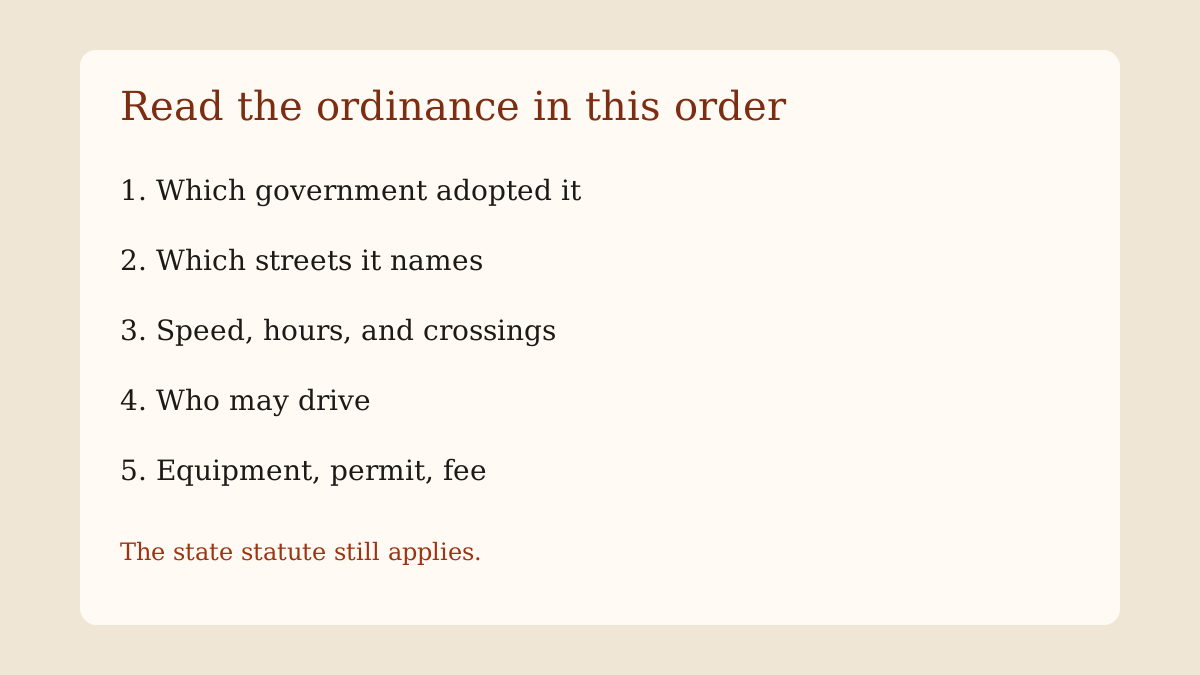
A state golf-cart statute usually ends with an assignment: the city, the county, or the town has to decide the streets. People then hit a municipal code that is eighty pages of traffic law and give up. The ordinance is readable if you take it in a fixed order and refuse to skip to the fee.
Who passed it, and under what statute
The caption or the first "whereas" clause should name the state section the city thinks it is using. Wynne's Ordinance 917 cites Arkansas Code section 14-54-1410. Dunedin's article cites Florida Statutes sections 320.01 and 316.212. If the ordinance cites nothing, be more skeptical, not less. A city council can pass a piece of paper. The state statute is what makes the paper an authorization instead of a wish.
Check the government. Illinois section 11-1426.1 says that if more than one unit of government has jurisdiction over a roadway, every one of them has to agree before non-highway vehicles may use it. A city ordinance does not open a township road. An Arkansas city cannot, under section 14-54-1410, authorize carts on a street that is also a federal or state highway or a county road. Wynne's ordinance then names Falls Boulevard, Martin Luther King, US 64, and Hamilton Avenue as closed, including to crossings unless the council approves a special occasion. The state statute and the city list are doing different jobs. Read both.
Which streets
Look for a list, a map section, or a definition of "city street." Dunedin does not say "all streets posted at 25." It says designated streets, inside named golf-cart zones, and it lists particular crossings of County Road 1, State Road 580, and US Alternate 19. Crossing anywhere else is unlawful in that code. A zone map that is not in the ordinance may still be the city's working map. Ask for the section that adopts it. A real-estate brochure is not that section.
Kentucky section 189.286 requires the ordinance to specify each roadway. A Kentucky ordinance that says "all streets 35 and under" may or may not satisfy "each roadway." That is a question for the city that wrote it, and for a reader who has the ordinance in hand. Do not assume the general phrase is enough because it sounds broad.
Speed, hours, and the crossing sentence
The state often sets the ceiling and lets the city go lower. Connecticut section 14-300g forbids a traffic authority from authorizing any street posted over 25, and it limits the permission to daylight. Florida's default is sunrise to sunset unless the city allows night and the cart has headlights, brake lights, turn signals, and a windshield. Wynne defines daylight, for its ordinance, as thirty minutes before sunrise until thirty minutes after sunset, and it allows night only with headlights, taillights, and brake lights. Dunedin does not ban night, but between sunset and sunrise the cart needs headlights, brake lights, turn signals, and a windshield, which tracks the Florida statute.
Crossings are where careful readers slow down. Ohio allows an under-speed vehicle to cross an intersection of a street posted over 35, and forbids using that street as the route. Kansas allows a golf cart to cross a road posted over 30 and forbids operating on it. Dunedin lists the crossings that are approved and says other crossings of state or county roads are not. If the ordinance is silent on crossings, go back to the state statute. Silence in the city code does not invent a crossing the state forbids, and it does not delete a crossing the state allows.
Who may drive
Florida section 316.212 splits age: under 18, a learner's license or a driver license; 18 or older, a government photo ID. Dunedin, on top of that, says the operator must hold and possess a valid driver license. The city chose the stricter rule. Connecticut requires the operator to carry a valid motor vehicle operator's license. North Carolina's city statute sets a floor at 16 that a city cannot lower. Kentucky requires a valid operator's license in possession. Minnesota's section 169.045 says the driver-license chapter does not apply to a permitted golf-cart operator, which is the opposite answer, and it is easy to miss if you assume every state copied Florida.
Write down the city's sentence and the state's sentence. If they conflict, figure out whether the state allows the city to be stricter. Florida section 316.212(8)(a) lets a city be more restrictive on operation and equipment, and it says that kind of ordinance applies only to an unlicensed driver. That is a strange limit. Read it before you announce that Dunedin's license rule is illegal or that it covers everyone. We are not your city attorney. We are telling you the two sentences exist.
Equipment, permit, and money
Equipment is a list, not a vibe. Illinois section 11-1426.1 requires brakes, steering, tires, a rearview mirror, red reflective devices front and rear, a slow-moving emblem, a headlight visible from 500 feet, a tail lamp visible from 100 feet, brake lights, and turn signals, and it says the headlight and tail lamps are lighted when the cart is on a roadway. A city can add to a state list. It should not be read to delete one unless the state says the city may.
The permit is a separate paragraph from the equipment. Peachtree City's own page says a new cart is registered in person at City Hall, only to an owner 18 or older, within 10 days of purchase, with proof of ownership and a photo ID. Decals go on the front and the rear. The fee block on that page, when we read it, listed a decal at $15 a year and a three-year resident cycle, and a nonresident path fee of $235 on top of the $15. Wynne charges $25 a year and $5 to replace a sticker. Dunedin's code, in the portion we used, sets an annual registration fee of $10. Those numbers are city law. They are not a national price.
Insurance shows up in some ordinances and in some state statutes, and it is absent from others. Louisiana's section 32:299.4 requires liability insurance at the minimums in R.S. 32:900(B). Kentucky points at KRS 304.39-080 and says the proof stays in the cart. Connecticut lets the motor vehicle commissioner adopt insurance regulations and makes a violation of those regulations an infraction. If the ordinance you are reading never says insurance, do not write "no insurance required" in the margin. Another statute may require it. Write "this ordinance does not say."
Signs, dates, and the grandfather
Georgia section 40-6-331 says an ordinance that sets operating standards for personal transportation vehicles is not effective unless the local government posts signs of at least 24 by 30 inches where a state highway meets the city or county line. Indiana section 9-21-1-3 says the golf-cart ordinance is effective when signs are posted at the highway or its entrances. A vote without signs may not be an enforceable rule yet. Ask.
Dates matter. Louisiana exempts parish and municipal ordinances that were already in effect before January 1, 2015, from the requirements of section 32:299.4. Georgia grandfathers some daylight carts under ordinances enacted before January 1, 2012, out of the newer equipment list. An old PDF in a Facebook group may be the grandfathered ordinance, or it may be the one the council repealed. Ask for the code as codified, and for the ordinance number of the last amendment. Peachtree City's page describes an October 2025 change to where decals go. A 2019 blog post will not have that.
What to do with a city we have not published
This site publishes a city page only after we have opened the ordinance. A missing town is not a yes and not a no. Email or call the clerk. Ask for the ordinance section, the state statute it cites, the street list or zone map, the fee, and whether signs are up. If you send us that link, we can read it the same way. Until then, the state page is the part we are willing to stand on.
A worked pass through one section
Take Dunedin as the model, because the code is public and it is more specific than a slogan. Start at the permission sentence: a person who holds and possesses a valid driver license may operate a golf cart, as Florida defines it, on designated streets, and only on the paved portion. The next sentences are the nos. Not sidewalks. Not parks or other city land. Not the Pinellas Trail or its spurs. Not undesignated streets. Golf courses and private land that allow carts are carved out, which is a reminder that private permission is not the ordinance.
Then the crossings. The code names County Road 1 crossings and state crossings at particular streets. It says the ordinance does not authorize travel on a state or county road, or a crossing, except where the state or county has approved it. Legal operation sits inside the Northside, Southside, and Eastside zones. Crossing a state or county road anywhere else is unlawful. If your address is "near" a named crossing, you are not at the crossing. The named intersection is the permission.
Then the equipment and the children. The code lists brakes, steering, a horn that meets Florida's horn statute, safe tires, a rearview mirror, amber reflectors in front and red reflectors in the rear. Between sunset and sunrise it adds headlights, brake lights, turn signals, and a windshield. Children 16 and under need lap belts. There is a registration decal and a $10 annual fee. None of that replaces section 316.212. It sits on top of it.
Do the same pass on your own city's PDF. If you cannot find a street list, a zone, or a sentence that says who may drive, you do not have a usable answer yet. You have a title. Go back to the clerk and ask for the section you could not find. That question is more useful than asking "are golf carts allowed here," which invites a yes or a no that the code will not match.