Private roads, golf communities, and the public street at the gate
Last updated
An HOA rule can govern a private road. It does not designate a city street. A few statutes do carve out master-planned communities and golf-course trips. The carve-out is narrow.
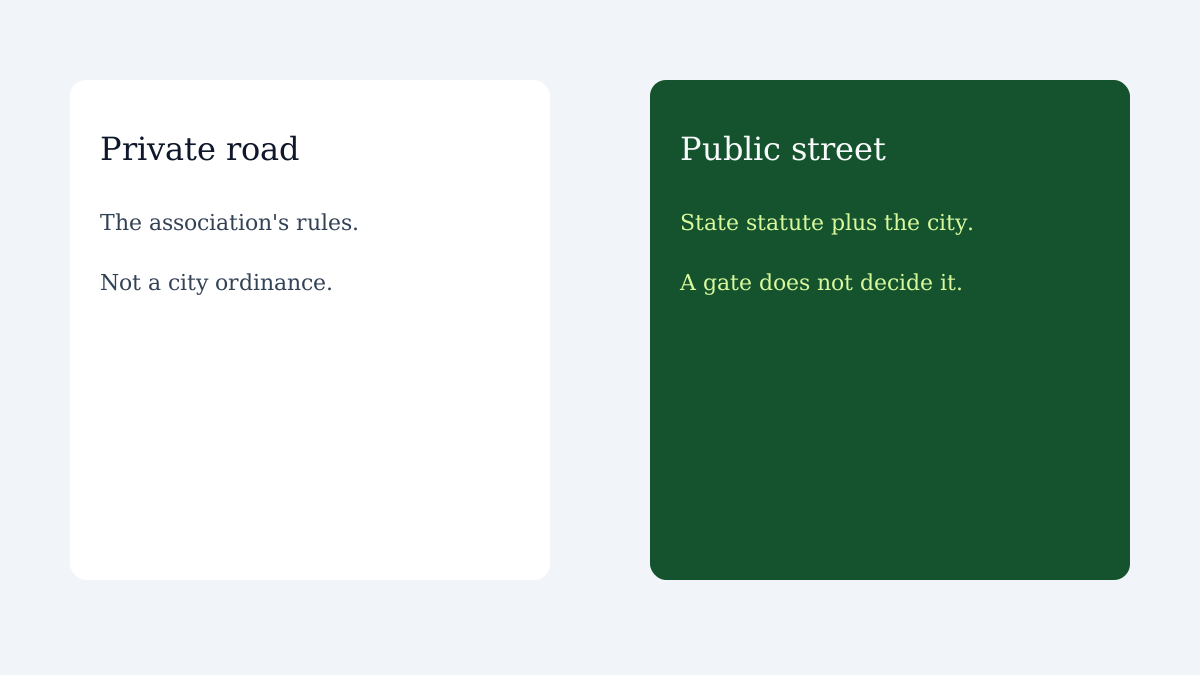
Golf-cart communities feel like the cart is the local car. Inside the gate, that can be an association rule, a private-road rule, or an actual public-street ordinance. Those are three different legal objects. Driving out the gate to a pharmacy tests which one you had.
What a private road is, and what it is not
If the road is privately owned and not dedicated as a public street, the state golf-cart statute often never turns on, because the statute is about public roads or highways. The association's covenants, the security guard, and the insurance the association requires are the rules of that road. They can be stricter than any state golf-cart law. They can require a windshield the state does not. They cannot, by themselves, authorize you to use the public road on the other side of the gate.
Indiana is unusually explicit about private roads and traffic ordinances. Section 9-21-1-2 lets a local authority adopt additional traffic regulations for a private road after a request from the property owner, with a recorded contract, and the ordinance still may not conflict with state law. That is a public government regulating a private road by agreement. It is not the HOA board quietly becoming the legislature. If your Indiana community says the county "approved the carts," ask whether that section was used and whether the contract is recorded.
Florida section 316.212(3) has a narrow mobile-home-park rule. Carts may cross the public street that splits one park, if the government with jurisdiction approves the crossing. Notice posted at the entrance is enough; the park does not need a gate for carts to be lawful inside the park. That subsection is for residents or guests of that park. It is not a rule for every gated subdivision.
When the statute itself mentions the community
Texas section 551.403 allows operation in a master planned community that is a residential subdivision as Property Code section 209.002(9) defines it, or that has a uniform set of restrictive covenants, and for which a county or municipality has approved one or more plats. On a highway in that community posted at 35 or less, the golf-cart license plate is not required, including through a faster intersection. A subdivision with a gate and a logo is not automatically that community. The plat approval and the statutory description have to be there. A city or county can still prohibit a 551.403 use for safety. The gate does not veto the prohibition, and the prohibition does not erase a truly private road the statute never covered.
California section 21115 lets a local authority designate a highway next to a golf course, or between the course and where carts are stored, or within a real estate development offering golf facilities. That phrase means an area of homes whose owners or occupants may use one or more golf courses in the development because they own or occupy a dwelling there. The designation generally may not run more than one mile from the course if the highway is outside the development. Signs have to be posted. A development with no golf eligibility is not the phrase, even if the marketing said "cart friendly."
Arizona section 28-721(C) is narrower than "retirement community." The shoulder rule applies in an age-restricted community in the unincorporated area of a county with more than three million people. An incorporated city, a younger neighborhood, or a smaller county is outside the sentence. Virginia's home-to-course exception is half a mile, on a road posted at 35 or less, not a community-wide pass.
The public street inside the neighborhood
Many "cart communities" dedicated the roads to the city or county. Those roads are public. The HOA rule is a contract among owners. The ordinance is the traffic law. You can violate one, the other, or both. Peachtree City is the clearest public example we published. The paths and the streets are a city system. Registration is at City Hall, not at a clubhouse desk. An architectural committee that allows a lifted cart does not amend Ordinance 1253.
If you are not sure whether a road was dedicated, the clerk or the county engineer can say. The presence of a gate is a weak clue. Some public streets have gates the city allowed. Some private roads have no gate at all. The plat is the document.
Leaving the community
The trip people want is the one the statutes are stingy about: out to a public road that is not part of the development, then back. Florida requires a designation of that public road, or one of the narrow crossings the statute names. Texas's five-mile daytime golf-course trip is not a grocery trip. California's one-mile designation is not a county-wide permission. Connecticut will not authorize a public street posted over 25 even if every house on it owns a cart.
Before you buy in a community because "everyone drives carts," ask three questions in writing. Are the internal roads public? If they are public, what ordinance designates them? What happens at the gate, on the first public road the cart would use? If the sales office cannot cite the ordinance, the lifestyle brochure is not a legal opinion. Neither is this page. It is a way to tell the brochure from the statute.
Guests, renters, and the cart that is not yours
Association rules often say members may drive and then stay quiet about guests. The state statute is usually written about the operator, not the owner. Florida's age and ID rule applies to the person driving, whether or not they own the house. Connecticut's license-in-hand rule does too. A guest who is legal on the private road can be illegal on the first public street, and a guest who is under the state's age floor is illegal on the public street even if the guard waved them through. If you rent the house for a week, ask whether the rental includes cart use on public roads or only inside the gate. "Cart included" on a listing is not a designation under section 316.212 or section 551.403.
Insurance follows the same split. Kentucky wants proof of insurance inside the cart on a public roadway, citing KRS 304.39-080. Louisiana wants liability insurance at the minimums in R.S. 32:900(B) for a cart on a designated public road. An association policy that covers the private roads may not be the policy those statutes are talking about. We do not sell insurance and we do not tell you a particular policy satisfies those sections. We are telling you to read the section and ask the insurer, in writing, whether a public-road trip is covered. A denial after a crash is a bad time to learn that the golf-course rider was the only use on the declarations page.
Delivery carts are not resident carts
Georgia section 40-6-331(e) lets certain large delivery companies use personal transportation vehicles inside residential subdivisions posted at 25 or less, with the state equipment list, a licensed driver, a company name on the cart, and a fee to the local government. Texas has a separate subchapter for package-delivery vehicles with their own plates. Those rules exist because a delivery cart is not the resident's cart. Do not cite the delivery subsection as your permission to do the same route in your own cart. The legislature wrote a narrow permission for a carrier. Your driveway is not a carrier.
When the community is the city
Some places are so identified with carts that people forget a city council still had to act. Peachtree City publishes registration rules, fees, and a path system, and it points readers to Ordinance 1253. The Villages, by contrast, is not a single municipality, and this site does not publish a page for it because we did not open one ordinance that covers every public street a resident might use. That absence is intentional. A community that spans counties can have different answers on different sides of a line. Ask which city or county maintains the particular road, then ask that government. A map of "cart paths" from a residents' association is a useful picture. It becomes a legal answer only when an ordinance adopts it. If the association and the city disagree, the public street follows the city and the state. The association can still enforce its contract on the private miles, including by suspending a gate card. Those are parallel systems. Learning which mile you are on is the whole skill. When you give directions to a guest, say which miles are public. "Follow the carts" is how a guest ends up on the arterial the residents themselves avoid. The residents have a mental map. The guest has your text message. Make the text message as specific as the ordinance. If you cannot name the public segments, tell the guest to leave the cart inside. That is a complete instruction. "Be careful" is not. Name the last public intersection they may cross, and tell them to turn around there.