Where a golf cart may drive
Last updated
A speed-limit sign is not permission. Most golf-cart statutes still require a local designation, and they treat crossing a fast road differently from driving along it.
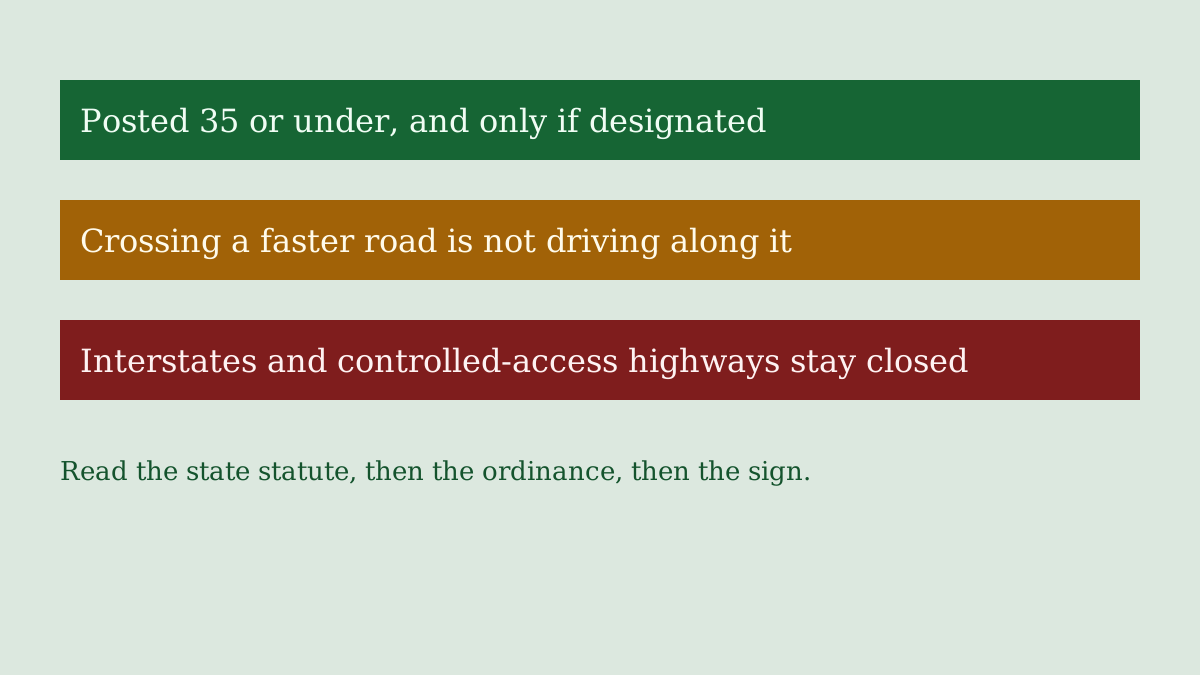
The question people actually have is not "what is a golf cart." It is "can I take this street." The statutes answer with a speed number and then take the answer back unless a government has designated the street. If you remember only the number, you will drive somewhere the statute still forbids.
The number is a ceiling, not a key
Connecticut will not let a traffic authority authorize a street posted over 25. Kansas makes it unlawful to operate a golf cart on a street posted over 30, and also on an interstate, a federal highway, or a state highway. Virginia's designated-highway limit is generally 25, with specific crossing exceptions at 35. Ohio's under-speed vehicle, the category that includes what the BMV calls a golf cart, may use a street only if the speed limit is not over 35 and a local authority has granted permission. Florida does not pick one statewide speed for every golf-cart road. The local government designates the road after looking at speed, volume, and character of traffic. A 25 mph sign in Florida is not, by itself, a designation.
Illinois is the clean version of the same idea. It is unlawful to operate a non-highway vehicle, including a golf cart, on any street unless a local government or the Department authorizes it. If they do, the cart may be used only on streets posted at 35 or less. North Carolina lets a city regulate carts on streets posted at 35 or less inside the city, or on property the city owns or leases. The city still has to pass the ordinance. Arkansas lets a city authorize city streets and forbids authorizing streets that are also federal or state highways or county roads. Indiana says a golf cart may not be operated on a highway except under an ordinance.
Write the ceiling on a card. Then write the word "designated" under it. If you cannot point to the ordinance that designated the block you are standing on, you do not have a legal route yet. You have a speed limit.
Crossing is its own sentence
Almost every statute that bans the fast road allows a crossing, and almost every driver treats the crossing as two more blocks. Ohio section 4511.214 says the ban does not prohibit proceeding across an intersection of a street posted over 35. It does not say you may turn and continue. Kansas says the bans do not prohibit crossing a federal or state highway or a street posted over 30. Texas section 551.405 says a golf cart may cross a highway at an intersection, including one posted over 35. Florida allows a state-highway crossing of a designated golf-cart road only if the Department of Transportation has approved the location and the traffic devices. A midblock crossing where a golf course sits on both sides of a state highway needs the same kind of approval. Dunedin, applying that statute, lists the crossings that exist and says other crossings of state or county roads are unlawful.
Kentucky is stricter about the cross street. The operator may not cross at an intersection where the road being crossed is posted over 35. Idaho's neighborhood-electric-vehicle section uses two numbers: do not travel on a highway posted over 35, and do not cross one posted over 45. The signs answer different questions. Read the sign on the road you are on, and the sign on the road you are about to cross.
Illinois adds a hard no to some crossings even at an intersection. No direct crossing of a tollroad, an interstate, or a controlled-access highway. A state highway that is not one of those may be crossed only at an intersection with another public street. A gap in the median is not an invitation.
The trip that is allowed without a general street ordinance
A few states allow a narrow trip even when the city has not opened every slow street. Texas section 551.403 allows a daytime trip on a highway posted at 35 or less, not more than five miles from where the cart is usually parked, for transportation to or from a golf course. It also allows a master planned community that meets the statutory description, and a beach open to vehicles. That five-mile golf-course trip is not a license to run errands. The purpose, the clock, and the distance are all in the sentence. Virginia allows a trip between home and a golf course of not more than half a mile either way, on a road posted at 35 or less, and a crossing between parts of a golf course, as exceptions to the usual 25 mph designated-road limit. California section 21716 keeps golf carts in a 25 mph speed zone, and section 21115 lets a city designate a highway next to a golf course or inside a golf development, generally not more than one mile from the course if the road is outside the development.
If your drive is "to the store and back," do not use the golf-course sentence. Find the ordinance that opens ordinary streets, or stay off them.
State highways, and who can close a road the statute opened
Texas lets a city or county prohibit a use that section 551.403 would otherwise allow, if the governing body decides the ban is needed for safety, and it lets the Department of Transportation do the same. Florida lets a local government be more restrictive. Georgia requires warning signs where a state highway enters a jurisdiction that allows personal transportation vehicles, and it limits state-highway crossings to designated active grade crossings. A road that looks open in the statute can be closed by a sign the city paid for. The sign is part of the law, not a suggestion.
Arizona's golf-cart shoulder rule is easy to over-read. Section 28-721(C) allows a golf cart or neighborhood electric vehicle on a paved shoulder, or at the right edge if there is no shoulder, only in an age-restricted community in the unincorporated area of a county with more than three million people. Section 28-777 says that driver yields to a same-direction vehicle turning right. It is not a statewide street rule.
Sidewalks and paths
Florida lets a local government allow carts on sidewalks next to specific street segments, after a safety finding and a consultation with the Department of Transportation, at no more than 15 mph, and only on sidewalks at least 8 feet wide when the sidewalk is next to a state highway. Peachtree City's path network is a city system with its own registration, not a sidewalk loophole in the Georgia code. A cart on a sidewalk in a state that has not authorized it is not "basically a bicycle." It is a motor vehicle in a place the statute did not open.
How to answer the street question for your block
Get the posted speed. Get the name of the government that maintains the road. Open the state page and see whether that government has to adopt an ordinance. Open the ordinance, if we have published it or the clerk will send it, and see whether the block is listed, zoned, or excluded. Then look for a crossing approval if the route crosses a faster road or a state highway. If any of those steps fails, the honest answer is that we cannot tell you the trip is legal. That is a better answer than a speed-limit rumor.
Two routes people invent, and why the statutes do not
The first invented route is "the neighborhood is 25, so the whole loop is fine." The loop usually includes one collector posted at 35 or 40 for two blocks. Connecticut cannot authorize that collector. Kansas cannot authorize it if it is over 30. Ohio cannot authorize an under-speed vehicle on it, though the cart may cross it at an intersection. Illinois cannot authorize operation on it, though a crossing at an intersection is allowed unless it is a toll road, interstate, or controlled-access highway. The two blocks are the violation. The rest of the loop being slow does not average the speed down.
The second invented route is "we only use it to cross." Crossing statutes are about the intersection, not about using the far side road as a shortcut back to a slow street three intersections away. Dunedin names the crossings. If yours are not named, the Florida statute still wants a DOT-approved state-highway crossing where a designated cart road intersects the highway, or the midblock golf-course crossing, or the mobile-home-park crossing. A convenient gap in traffic is not one of those.
Write the route down as a list of road names and posted speeds before you drive it the first time. If you cannot fill in the ordinance section next to each public segment, do not make the trip while you "figure it out." The figuring out is the task. The driving is what the statute is regulating. A golf community that has done this work will be able to hand you the list. One that tells you not to worry has not done the work, and the ticket will not be issued to the sales office.