Who may drive a golf cart on a public street
Last updated
Some states require a driver's license. Florida lets an adult use a photo ID. Minnesota says the license chapter does not apply to a permitted cart. The sentence in your statute is the one that counts.
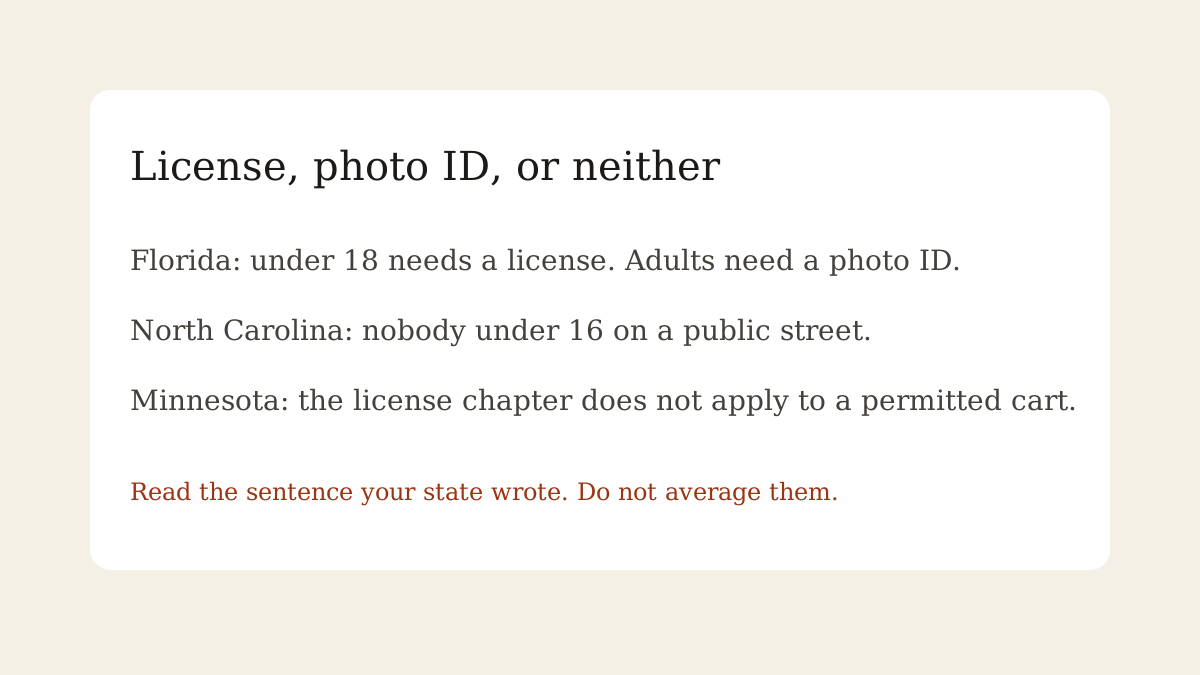
"Do you need a license?" is a bad question until you name the state. The answers in the statutes we read are not variations on one rule. They are different rules. Averaging them produces a sentence none of the states enacted.
A license in the hand
Connecticut section 14-300g says the operator shall carry a valid motor vehicle operator's license while operating the golf cart. Kentucky section 189.286 says the operator has a valid operator's license in his or her possession. Virginia section 46.2-916.3 says no person shall operate a golf cart or utility vehicle on a public highway unless he has a valid driver's license in his possession. Illinois section 11-1426.1 says a person may not operate a non-highway vehicle on a street without a valid driver's license issued in that person's name by the Secretary of State or a foreign jurisdiction. Iowa section 321.247 allows city-street operation by persons possessing a valid driver's license. Montana section 61-8-391 says the person operating the cart must have a valid driver's license. Louisiana section 32:299.4 says no person shall operate a golf cart on a parish road or city street without a valid driver's license. South Carolina's current golf-cart section, as we read it in the code, requires the operator to be at least 16, hold a valid driver's license, and have it in possession.
Those sentences are the strict set. A learner permit is not mentioned. A photo ID from the passport office is not mentioned. If your state is in this paragraph, plan on a license you can hand to an officer.
Florida's split, and cities that tighten it
Florida section 316.212(7) is not in that set. A person under 18 may not operate a golf cart on a public road or street unless they have a valid learner's driver license or a valid driver license. A person 18 or older needs a valid government-issued photographic identification. The statute does not say the adult needs a driver license. An adult with a state ID card and no license fits the words of subsection (7).
A city can still be stricter for an unlicensed driver. Subsection (8)(a) lets a local government adopt operation and equipment rules more restrictive than the statute, and it says an ordinance referred to in that paragraph must apply only to an unlicensed driver. Dunedin's code says the operator must hold and possess a valid driver license. That is a city sentence on top of the state sentence. If you live in Dunedin, follow Dunedin. If you live in a Florida city that has not added a license rule, do not borrow Dunedin's. And do not tell a 16-year-old that a photo ID is enough. Under 18, Florida wants the learner's license or the driver license.
A floor the city cannot lower
North Carolina section 160A-300.6 lets a city decide who may operate a golf cart, and then it sets a floor: no person less than 16 years of age may operate a golf cart on a public street, road, or highway. The city can require a license. It cannot authorize a 14-year-old on a public street under this section. Colorado's local-authority paragraph says an ordinance may not authorize operation of a golf car by a person under 16, and may not authorize an unlicensed driver to carry a passenger under 21. Those are limits on what the ordinance is allowed to permit. They are not a finding that every 16-year-old may drive without a license. Washington's golf-cart zone statute says the operator must be at least 16 and must have completed a driver education course or have previous experience driving as a licensed driver. A person whose license was revoked under the statute the section cites may not operate a golf cart in the zone.
The state that steps out of the license chapter
Minnesota section 169.045, subdivision 7, says chapter 171 does not apply to a person operating a motorized golf cart under a permit on a designated roadway. Chapter 171 is the driver-license chapter. The same subdivision says it does apply to mini-trucks. A Minnesotan who reads a Florida blog and demands a license, and a Minnesotan who reads this paragraph and hands the cart to a child, can both be wrong. The permit ordinance may require a physician's certificate that the applicant can operate safely. The city can add conditions that are not inconsistent with the section. "The license chapter does not apply" is not "anyone may drive." It is a specific exemption for permitted golf-cart operation on designated roads. Read the permit rules before you treat it as a family free-for-all.
States that do not say
Texas sections 551.401 through 551.405, Kansas section 8-15,108, and several LSV-only states do not, in the text we read, state a minimum age or a license rule for the golf cart. We do not convert that silence into "no license required," and we do not convert it into "a license is required." Other traffic statutes can still apply. A city ordinance can add a license rule, as Conway, Arkansas did when it required the owner to be at least 16 with a valid operator's license in possession. The state page on this site says when we did not find an age rule. That sentence is an invitation to read further, not a permission slip.
Passengers are not drivers, except when the statute cares
Colorado's limit on an unlicensed driver carrying a passenger under 21 is about the passenger, not only the driver. South Carolina requires a fastened safety belt for each golf-cart passenger under 12 on public streets, with a golf-course exception in the section. Dunedin requires lap belts for children 16 and under. Kentucky's definition caps the cart at six people including the driver, which is a design limit, not a suggestion that six people should ride. Indiana tells a county ordinance to set a passenger limit other than the operator. If the statute counts seats or belts, the extra person is part of compliance. A lap child is still a person in the seat the statute is counting.
The practical step is dull. Open the state page. Copy the license sentence into a note. Then open the city ordinance and copy its sentence. If the city is stricter, follow the city when the state allows that. If the city is silent, follow the state. If both are silent, call the clerk before a teenager takes the cart to school. A blog that says "most states require a license" is not a defense, because your state may be the one that does not, or the one that requires more.
Learners, suspended licenses, and "I used to have one"
A learner's license shows up expressly in Florida for drivers under 18. It does not show up in the Connecticut, Kentucky, Virginia, Illinois, Iowa, Montana, or Louisiana sentences we quoted, which say a valid driver's license or operator's license. Whether a learner permit counts as that license is a question for the licensing statute, not for a golf-cart blog. Do not assume it counts. Washington's zone rule is different again: at least 16, and either a completed driver education course or previous experience driving as a licensed driver. A person whose license was revoked under the section Washington cites may not operate a golf cart in the zone. A suspension or revocation is not cured by the fact that the vehicle is small. If your license is not currently valid, do not treat the cart as the thing you are allowed to drive instead.
Georgia's personal-transportation-vehicle rule requires a valid driver's license except in a locality whose ordinance allowed carts or motorized carts on streets without a license before January 1, 2012. That grandfather is about the place, not about a driver who personally used to be unlicensed. If you are not in one of those localities, the license sentence applies. Peachtree City's LSV path rule, separately, says licensed drivers only. Its ordinary cart registration is about the owner being 18, which is an ownership rule, not a substitute for the state license rule when the cart is on a street where the license rule applies.
Why age rules and license rules are not the same dial
North Carolina's 16 is an age floor on a public street. Colorado's 16 is a limit on what an ordinance may authorize. Florida's 18 is the line between "license or learner's license" and "photo ID." Kentucky's rule is a license in possession, with no age restated in the subsections we read in full, so the age is whatever the operator's license itself requires. Minnesota steps out of the license chapter for a permitted cart and may still let the city demand a doctor's certificate. Putting these on one slider called "maturity" hides the mechanism. The mechanism is what an officer, a clerk, or a parent can look up. Write the mechanism down. If you are deciding whether a specific teenager may drive a specific cart on a specific public street, you need the state sentence, the city sentence, and the status of that teenager's credential. Two out of three is how families get surprised.