A golf cart is not a low-speed vehicle
Last updated
Federal rules draw the line at 20 and 25 mph. State golf-cart statutes are a different set of rules, and a sticker does not move a cart from one box to the other.
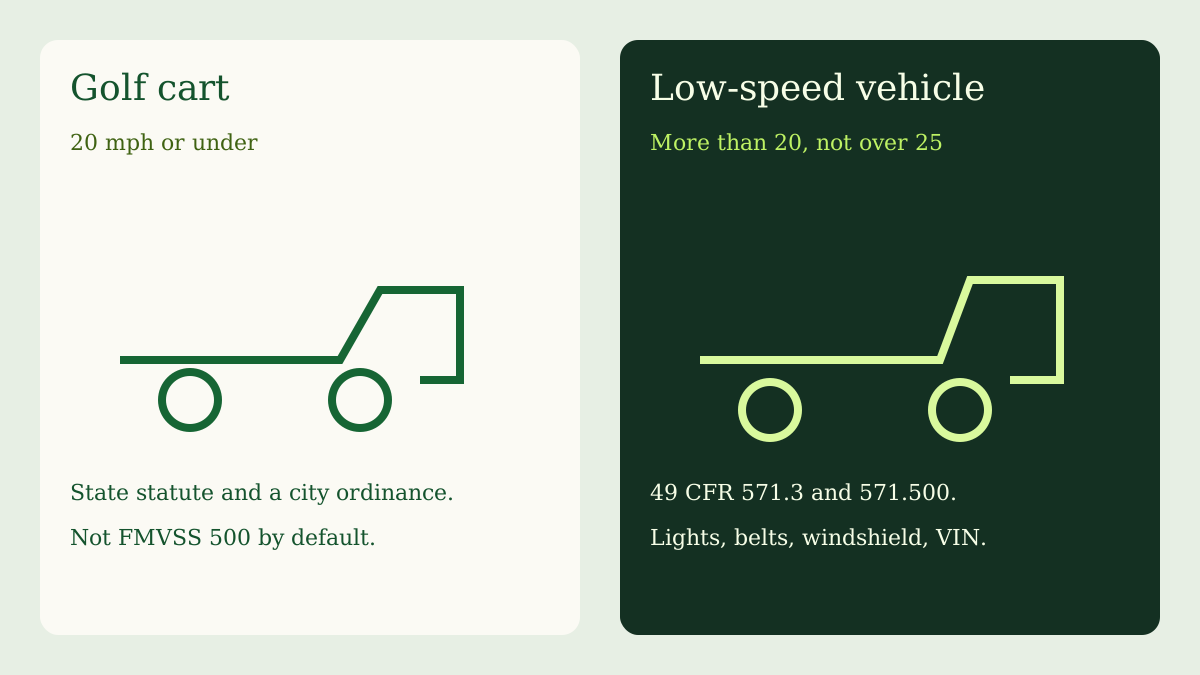
People use one phrase, "street legal golf cart," for two machines the law keeps apart. One is a golf cart. The other is a low-speed vehicle. They can look alike in a driveway. They are not registered the same way, they are not equipped the same way, and a city ordinance that mentions one does not automatically mention the other.
The federal line
A low-speed vehicle, in 49 CFR 571.3, is a motor vehicle that is four-wheeled, whose speed attainable in one mile is more than 20 miles per hour and not more than 25 miles per hour on a paved level surface, and whose gross vehicle weight rating is less than 1,361 kilograms, which is 3,000 pounds. All three pieces have to be true. A three-wheeled cart is out. A vehicle that tops out at 19 is out. A vehicle that can do 28 is out. A vehicle over the weight rating is out.
Standard No. 500, 49 CFR 571.500, is the equipment standard for that class. Its stated purpose is to make sure low-speed vehicles used on public streets have the minimum equipment appropriate for motor vehicle safety. The standard lists headlamps, front and rear turn signals, taillamps, stop lamps, reflex reflectors, an outside mirror on the driver's side and either an outside passenger mirror or an inside mirror, a parking brake, a windshield that meets the glazing standard, a VIN that meets the VIN rules, and a Type 1 or Type 2 seat belt at each designated seating position. The current standard also points at rear visibility under Standard No. 111 and an alert sound under Standard No. 141. Read the eCFR page rather than a dealer's laminated card, because the standard has been amended.
A golf cart built to stay at or under 20 miles per hour does not meet the speed band. It is not an LSV that forgot its seat belts. It is a different vehicle, and the street rules for it, if any exist, are in a state statute.
What states call the slow cart
States do not share a vocabulary. Florida's section 316.212 is titled as golf carts and never mentions the federal 20-to-25 band. The Florida rule is about designated roads, daylight, a short equipment list, and who may drive. Texas defines a golf cart as a motor vehicle designed by the manufacturer primarily for use on a golf course, and it tells the Department of Motor Vehicles not to register that cart for highway operation even if someone has altered it. California's section 345 is tighter still: not less than three wheels, unladen weight under 1,300 pounds, designed to be and operated at not more than 15 miles per hour, and designed to carry golf equipment and not more than two people including the driver. The DMV manual says a cart modified to go faster than 15, or to carry more than two people, is a regular motor vehicle that has to meet the federal standards for a passenger vehicle, not a golf cart with a bigger number painted on it.
Georgia splits the words on purpose. A personal transportation vehicle, in the 2025 code text of section 40-1-1, is the under-20 vehicle, with the weight and passenger limits the definition states, plus an older "motorized cart" branch for vehicles a local government had already authorized before 2012. A low-speed vehicle, in the same definitions section, is the four-wheeled vehicle whose top speed in one mile is greater than 20 and not greater than 25, manufactured or converted to comply with standards based on 49 CFR 571.500. Peachtree City then treats the two differently on its paths. An ordinary cart gets a city decal. An LSV on the path has to be limited to 20, registered and insured under Georgia law, tagged through the Fayette County Tag Office, driven by a licensed driver, and fitted with an amber strobe.
Ohio's Bureau of Motor Vehicles affidavit quotes the Revised Code for an under-speed vehicle: three or four wheels, attainable speed not more than 20, gross vehicle weight under 3,000 pounds, "including what is commonly known as a golf cart." Section 4511.214 then regulates under-speed vehicles and low-speed vehicles in different sentences. The under-speed vehicle needs local permission even on a 35 mph street. The low-speed vehicle is barred from streets posted over 35, and the section does not add the same "local permission" clause to that sentence.
New Hampshire's opened statutes do not use the words golf cart at all. They define a neighborhood electric vehicle as a four-wheeled electric vehicle whose maximum speed is greater than 20 and not greater than 25 and that complies with 49 CFR 571.500, and they limit that vehicle to ways posted at 35 or less. Alaska's DMV says a low-speed vehicle "may include golf carts among other examples," and then lists the 20-to-25 band, four wheels, and the 3,000 pound rating. A cart that cannot do 20 is not inside that "may include."
A governor does not re-label the vehicle
People try to solve the category problem with a screwdriver. NHTSA has said, in a published interpretation, that there are no circumstances under which adding a speed-governing device to a high-speed vehicle makes that vehicle a low-speed vehicle. The point of the LSV class was not to let a car that could go highway speeds put on a limiter and skip the rest of the federal standards. The same logic runs the other direction in state DMV pages. Alaska says a vehicle modified to exceed 25 can no longer be registered as an LSV. California says a golf cart modified past 15 mph or past two occupants is a regular motor vehicle. South Carolina's low-speed vehicle sections, as summarized from the code the legislature posts, say the state shall not issue VINs to homemade low-speed vehicles or retrofitted golf carts, and those vehicles shall not qualify as low-speed vehicles.
If a seller tells you a governor "makes it street legal," ask which sentence they mean. A governor that holds a cart under 20 keeps it out of the LSV definition. It does not satisfy Standard 500, because that standard does not apply to a non-LSV, and it does not satisfy a state golf-cart statute that never mentioned a governor. A governor that holds a faster homemade vehicle between 20 and 25 does not, by NHTSA's interpretation, create an LSV out of a vehicle that was not manufactured as one.
How to tell which page of this site to read
Look at the manufacturer's statement of origin or the certificate of origin before you look at the city ordinance. If the paper says low-speed vehicle or neighborhood electric vehicle and cites compliance with Standard 500, you are in the LSV world. Read the state page for the LSV road rule, which is often "35 mph roads, licensed driver, registered and insured," and then read whether the city may ban that road. Delaware's DMV, Hawaii's section 291C-134, Idaho's section 49-663, and Alaska's DMV page are written in that world.
If the paper says golf cart, off-road, or for golf course use, you are in the golf-cart world. Read the state golf-cart statute. In Florida, Texas, Illinois, Kentucky, Indiana, Arkansas, Connecticut, and a long list of others, a public street is closed until a local government acts. The federal equipment list is the wrong checklist. The state list, plus the city's list, is the right one.
If the paper says both, or the cart has been rebuilt, stop and ask the state motor vehicle agency. This site will not pick a category for a vehicle we have not seen. The cost of guessing wrong is a ticket, an insurance denial, or a cart the DMV will not title. The categories exist so that a 12 mph course cart is not held to a windshield standard written for a 25 mph vehicle, and so that a 25 mph vehicle is not waved onto a street with nothing but a rearview mirror because someone called it a golf cart.
A driveway test that does not require a lawyer
Park the cart and read the paper that came with it, not the decal a previous owner stuck on the fender. Write down the top speed the manufacturer claimed and the number of designated seats. Then open the state page on this site and use only the definition that state actually wrote.
If you are in California, section 345 asks about 15 mph, two people, golf equipment, and 1,300 pounds unladen. A four-seat lift is already outside that sentence, whatever the speedometer says. If you are in Texas, section 551.401 asks whether the manufacturer designed it primarily for a golf course. A neighborhood electric vehicle that never was a course cart does not become one because you drive it to the clubhouse. If you are in Kentucky, section 189.286 builds the lamps, the belts, the horn, and the 35 mph design speed into the definition itself. A bare cart fails the definition before anyone asks about the ordinance.
Then ask one local question: has a city, county, or town adopted the ordinance the state statute requires, and does it name this street? Florida, Illinois, Indiana, Arkansas, Connecticut, Kentucky, and Ohio all require that local step for the slow cart, in the sections we cite on their state pages. An LSV often does not need that same ordinance, and sometimes the city is allowed only to restrict it, not to invent the permission. Mixing those two answers is how a household ends up with a legal cart and an illegal trip, or the reverse.
If the paper and the statute disagree with the seller, believe the paper and the statute. Bring both to the DMV or the city clerk. Do not bring a printout of a forum thread. We would rather you leave with a shorter list of streets than with a category we invented.