Modified golf carts, governors, and the speed that changes the category
Last updated
Raising or limiting the top speed can move a vehicle out of the golf-cart statute. A speed governor does not turn a fast vehicle into a low-speed vehicle.
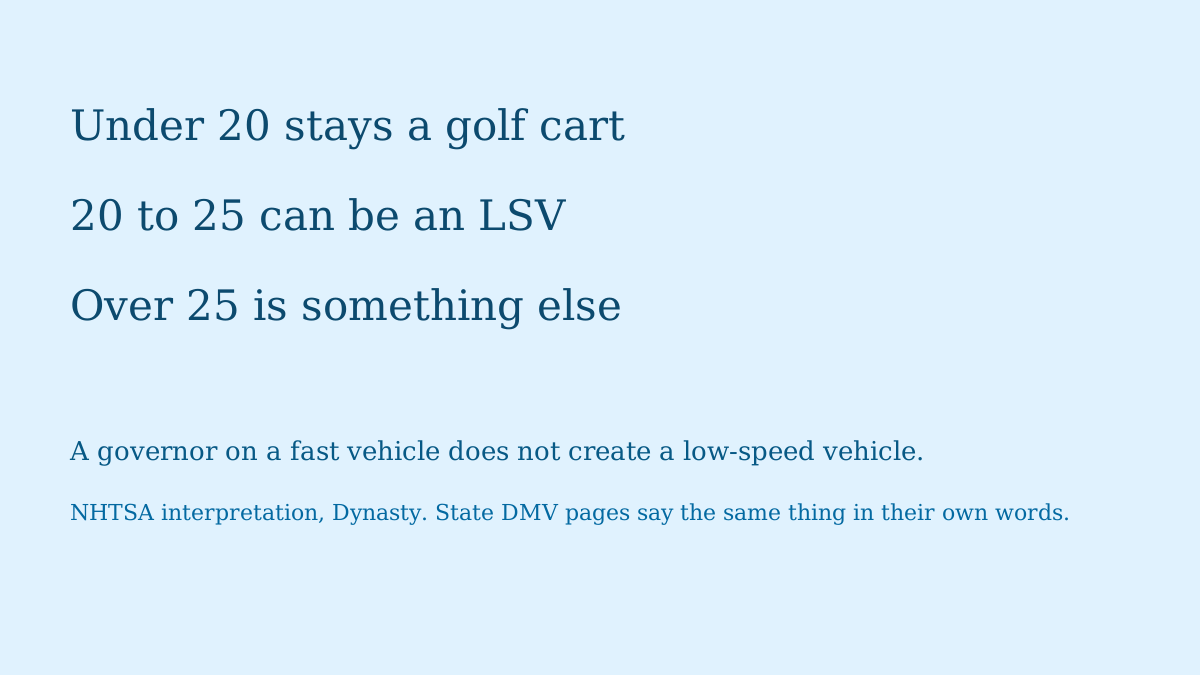
The modification people want is more speed. The modification the law notices is a change of category. A golf cart, a low-speed vehicle, and a passenger vehicle are three regulatory boxes. The top speed is one of the walls between them. Seats, weight, and what the certificate of origin says are the others. A lift kit is a different conversation. A governor is not a magic label.
The federal boxes
Under 49 CFR 571.3, a low-speed vehicle is four-wheeled, able to go more than 20 miles per hour and not more than 25 on a paved level surface, and rated under 3,000 pounds. Standard 500 applies to that vehicle. A cart that cannot exceed 20 is not in the box, so Standard 500 is not the golf-cart equipment code. A vehicle that can exceed 25 is not in the box either. It is, if it is a motor vehicle for highway use, in the world of the ordinary federal standards, which are much longer.
NHTSA has addressed the temptation to use a governor to climb into the LSV box from above. In an interpretation involving a speed-governing device, the agency said there are no circumstances under which adding a speed-governing device to a high-speed vehicle makes that vehicle meet the low-speed vehicle definition. The LSV category was not created so that a vehicle capable of ordinary highway speeds could be limited and then excused from the rest of the safety standards. If you are looking at a used "street legal" cart that started life as something faster, ask what it was manufactured as. The governor is not the answer NHTSA gave.
What state agencies do with the same idea
California's DMV manual says a golf cart modified to travel more than 15 miles per hour, or to carry more than two persons including the driver, is a regular motor vehicle and must comply with the federal standards for a regular passenger vehicle. Section 345 is the definition that makes that sentence inevitable: not more than 15 mph, not more than two people, golf equipment, under 1,300 pounds unladen. A lift that adds seats is a category change even if you leave the governor at 14. The manual also says a cart over 1,300 pounds unladen cannot be registered as a golf cart.
Alaska's DMV says that if an LSV is modified to exceed 25, it no longer meets the LSV requirements, cannot be registered as an LSV, and may not meet the federal standards for passenger registration, so it becomes ineligible on that path. The certificate of origin has to say the vehicle complies with federal highway safety standards before a passenger registration is even in view. South Carolina's low-speed vehicle provisions, as we read them, say the state shall not issue VINs to homemade low-speed vehicles or retrofitted golf carts, and those vehicles shall not qualify as low-speed vehicles. A retrofit is not a paperwork error. It is a disqualification in that section.
Alabama's registration rule says a golf cart manufactured for a golf course cannot be titled or registered unless the origin document shows federal safety-standard compliance and the official inspects it. An off-road-only statement on the bill of sale blocks registration. Speeding the cart up does not erase that sentence. It can make the federal-compliance problem harder, because a modified off-road cart is not a vehicle the manufacturer certified.
Design speed inside the golf-cart definition
Some states put a speed into the definition of the cart the statute is willing to talk about. Wynne's ordinance says not capable of exceeding 20. Colorado's statutory golf car has a design speed of less than 20. Kentucky's section 189.286 cart is designed to operate at not more than 35, which is a different ceiling, and it also has to have the lamps and belts in the definition. A Kentucky cart at 30 is still inside that state's definition and outside the federal LSV band. Do not "correct" it into an LSV to make it sound safer. You may take it out of KRS 189.286 and fail to land in Standard 500.
Louisiana defines a golf cart as electric, four-wheeled, originally for golf courses and green spaces, maximum speed 25. That 25 sits on the LSV line. The rest of the definition still has to be true. A gasoline cart fails "electric." A cart that will do 30 fails the maximum. We do not resolve, in this guide, whether a Louisiana cart at exactly 25 is also an LSV under federal law. We tell you the state sentence and the federal sentence are both real, and the certificate of origin is how the DMV will sort a particular vehicle.
What a careful owner does before turning a screw
Write down the manufacturer's stated top speed, the number of seats, the power source, and the words on the certificate of origin. Read the definition on your state page. If the change you want would cross a number in that definition, stop and ask the motor vehicle agency what the vehicle becomes. Ask in writing if you can. A verbal "you're fine" from a dealer is not the agency.
If you are adding lights, a mirror, a flag, or a belt to meet a list the statute already applies to your current category, that is not a category change. It is compliance. If you are adding a motor, a controller, or a governor to change the top speed, it is a category question. The equipment guide on this site is for the first kind of work. This one is for the second. Do the second first, because there is no point buying Florida's night kit for a vehicle you have just turned into something Florida's golf-cart section does not cover.
We are not engineers, and we are not telling you a particular controller is safe. We are telling you the legal boxes are drawn in miles per hour and in the manufacturer's paperwork. Measure the project against those boxes before you measure it against a forum's quarter-mile time.
Seats, weight, and tires count as modifications too
Speed is the modification people brag about. Seats are the one that quietly exits the definition. California section 345 is not more than two persons including the driver. A rear seat kit is a different vehicle in the DMV's own manual, which says the cart must then meet passenger-vehicle federal standards. Colorado's golf car carries not more than four persons and weighs not more than 1,300 pounds empty. Kentucky's definition stops at six people, 2,500 pounds gross, and 1,200 pounds of payload, and it requires the belts and lamps as part of being a golf cart at all. Adding a seat without adding the belt Kentucky already requires does not make the cart more legal. It can make the cart no longer the thing the ordinance is allowed to permit.
Weight matters at the county scale too. Alabama will not treat a golf-course cart as registerable unless the origin papers show federal compliance. Piling on batteries and a cargo box does not create that paperwork. Georgia's personal transportation vehicle definition, in the 2025 text we read, caps unladen or empty weight at 1,375 pounds for the newer branch and 1,300 for the older motorized-cart branch. Peachtree City's registration form, which we did not treat as a substitute for chapter 78, is a reminder that the city enforces a physical cart, not a concept. If you are over the weight before you leave the driveway, the sticker conversation is premature.
A rebuild is a new vehicle for the VIN rules that say so
South Carolina's refusal to issue a VIN to a retrofitted golf cart is the blunt version. Other states express the same suspicion through the certificate of origin. If the paper you have describes a different motor than the motor in the cart, you do not have a chain of identity. Texas will not solve that by registering the result as a highway vehicle. Section 551.402 says the department may not register a golf cart for highway operation regardless of alteration. The special golf-cart plate is not a way to bless a home-built speed project. It is a plate for a golf cart operated in the ways the subchapter allows.
If your project is lights and a mirror on an unchanged cart, you are in the equipment guide. If your project changes speed, seats, or the power unit, stop and get a written answer from the motor vehicle agency about what the vehicle is. Bring the origin document, photographs, and the state definition. Do not bring a plan to "see if they notice." The category is the thing that decides which equipment list, which road, and which insurance conversation you are in. Guessing is how a legal golf cart becomes an unregistered motor vehicle with a golf-cart body. If the agency's written answer surprises you, believe the letter. It is cheaper than a second rebuild aimed at a category you have already left.